
The Manager’s Guide to Relationship-Building
Few relationships shape our workplace experience more than the one we have with our manager. If our schools and organizations are organisms, staff-manager relationships are the connective tissue—they bind, support, and protect us.
This guide on how to build strong relationships at work is for managers who want (more) supportive and functional relationships with their staff. Preview a summary below, or jump right to the full guide:
Unlock your full potential as a manager by enrolling in our Foundations course Managing to Change the World! Gain the confidence, tools, and strategies to delegate effectively, have high-quality check-ins, check your biases, build relationships with your team, and more! Level up your leadership and sign up today.
Preview the guide:
Why is Relationship-Building Important for Managers?
We believe that relationship-building is a core competency for effective management (equitable, sustainable, and results-driven). Even though relationships are a two-way street, it’s the manager’s responsibility to drive and prioritize the work of relationship-building.
How Do You Build Effective Relationships in the Workplace?
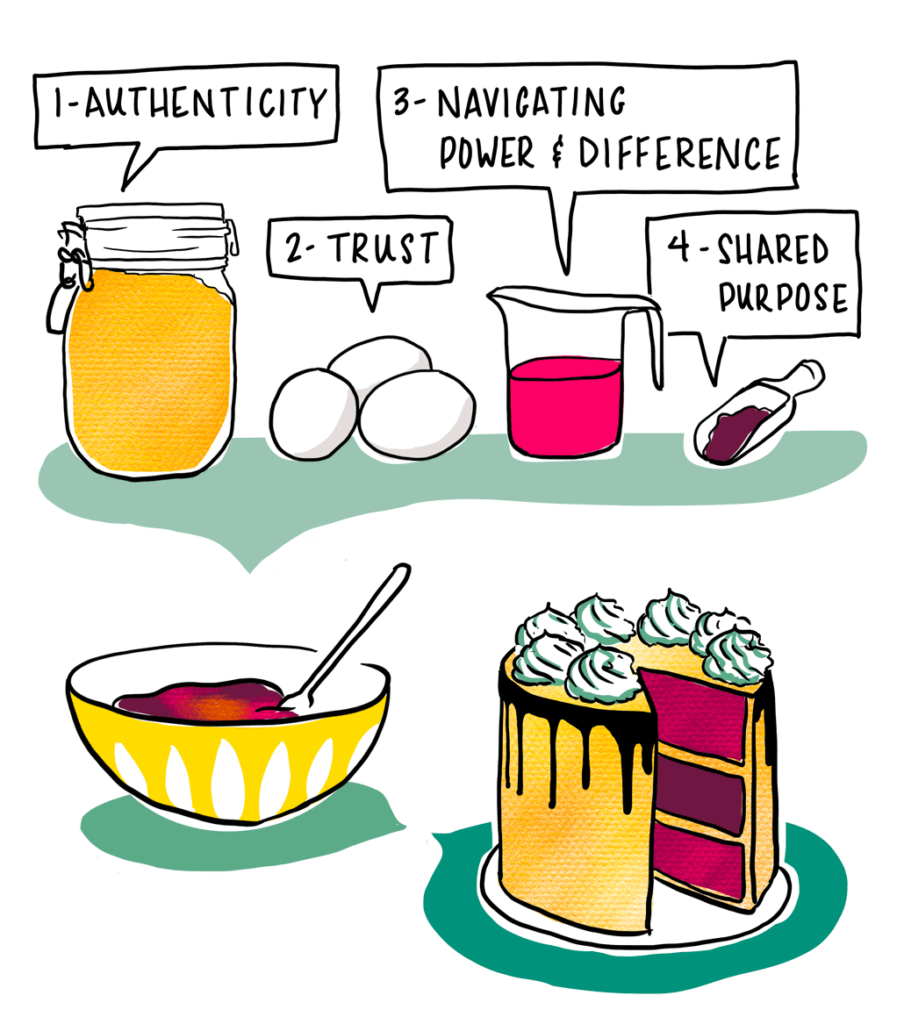
Building strong relationships is the cornerstone skill of effective management. Your relationships with your staff should have four key elements: authenticity, trust, effective navigation of power and difference, and shared purpose.
Think of the four elements as ingredients. Consider a cake—the eggs, sugar, butter, and flour don’t just sit on top of each other. They bind and react, yielding new flavors, textures, and shapes. The final product results from the quality of the ingredients, skillful execution, and finally, time.
Whether you’re a new or experienced manager, use this framework to build meaningful connections with your team.
1. Authenticity: create space for your whole selves
Building authenticity starts with showing up as your full self—and inviting your team to do the same. Authenticity means seeing your staff not just as employees, but as whole people with dreams, challenges, and unique qualities.
Tips to build authenticity in workplace relationships
- Be a person: Align your values with your actions, be honest about your mistakes, model vulnerability, and work on your growth areas.
- See a person: Be attentive to each staff person. Ask them, “What do you think success would look like in our working relationship?” By seeing your staff’s full humanity, you set yourself up to treat them as people you exercise power with, not power over.
- Challenge perfectionism: Remind your staff that they don’t need to be perfect to belong. When mistakes happen, create space for growth and authenticity without judgment.
- Use the “green lens:” Approach your staff with an empowering lens. They have their own goals and answers, and deserve dignity and respect.
2. Trust: earn and communicate reliability
Trust is the lifeblood of strong relationships. Your job as a manager is to cultivate and communicate trust consistently through your daily actions.
How to build trust at work
- Act with care: Small gestures—like checking in, offering help, or celebrating wins—show your team you’ve got their back.
- Act with integrity: Follow through on your commitments and be transparent about your decisions.
- Demonstrate competence: Leverage your strengths and work on your growth edges. You don’t need to be perfect, but you do need people to believe they can count on you.
- Communicate trust: Create opportunities for your staff to take leadership. Invest in their growth, and make it clear you believe in their potential.
3. Power and Difference: navigate with intentionality
Every manager has to navigate differences in identity, power, and privilege with their staff—including positional power. By intentionally naming and confronting these differences, you can more effectively leverage your power for equity, sustainability, and results.
Best practices to navigate power and difference
- Acknowledge context: All of our experiences are shaped by systems of oppression in different ways. Work to understand how these experiences influence the way you show up in relationships with your colleagues.
- Lead with curiosity: When confronted with difference, listen to understand, ask probing questions, and suspend judgment (don’t climb the ladder of inference).
- Address conflict proactively: Conflict can help you shift how you work together to get better outcomes. Name tensions early, look for the iceberg, and find breakthroughs together.
- Use your power for good: What can you do to advance equity, particularly for your most marginalized staff? Examine your choice points.
4. Shared Purpose: align on why you’re here
Shared purpose brings clarity and cohesion to your team and it’s central to a conspire and align approach to management. It’s not just about tasks—it’s about what you’re trying to achieve together and how you want to get there.
How to build shared purpose
- Foster strong team culture: Align on your team’s goals and values. Develop team traditions that build belonging and connection.
- Define and clarify roles: Make sure everyone knows how their work contributes to the whole.
- Build collective responsibility: Give and receive regular feedback, celebrate wins, and implement lessons learned.
Strengthening Workplace Relationships for Long-Term Success
Meaningful workplace connections can support staff to feel valued, engaged, and motivated to collaborate effectively. Relationships built on trust, authenticity, shared purpose, and effective navigation of power and difference can drive higher job satisfaction, promote long-term retention,and advance equity in the workplace. Building these strong relationships requires intentionality, mutual respect, and continuous reinforcement.
Assess your current team dynamics and identify one small, impactful change you can make this week. Whether providing more autonomy, offering constructive feedback, celebrating achievements, or simply checking in on a staff person, these actions can make a lasting difference in workplace relationships.
How to foster a supportive work environment
Below are key strategies to cultivate a workplace where everyone thrives.
- Check in with your staff: Ask about and share your preferences, traditions, or requirements when it comes to relationship-building. “What do you think success would look like in our working relationship?”
- Delegate with the “why”: Be explicit about the “why” of a task or project. Share how the assignment will advance the overall goal, mission, or purpose of your team.
- Invest in their growth: Help them develop their skills, whether through direct training or supporting professional development.
- Be real about decision-making: For difficult decisions, share what you were wrestling with: “This was a hard decision to make. I was worried that ___ and I was uncertain about ___. Ultimately, I decided to do XYZ because ___.”
- Share feedback early and often: Offer constructive feedback as soon as you spot potential issues, even if they seem minor. “I’d like to address something that isn’t a huge deal right now, but might be an issue if it becomes a pattern.”
Ready for more? Download the full guide below.
Download the Full Guide Now
The Four Elements of Strong Relationships: The Manager’s Guide to Relationship-Building is available for free download.
Note: The PDF version of this guide is not fully accessible for screen readers. If you use a screen reader, please use the Google Docs version.

Monna is the Chief Content Officer at The Management Center and co-author of “Management in a Changing World: How to Manage for Equity, Sustainability, and Results.” Monna also serves on TMC’s leadership team.