
Key Takeaways
- Effective management blends equity, sustainability, and results.
- Effective managers cultivate belonging, strong relationships, and a sense of shared purpose. They create a team culture where people feel supported and motivated to contribute to success.
- Managers need essential skills like delegation, goal-setting, giving/receiving feedback, and inclusive decision-making.
What is Effective Management?
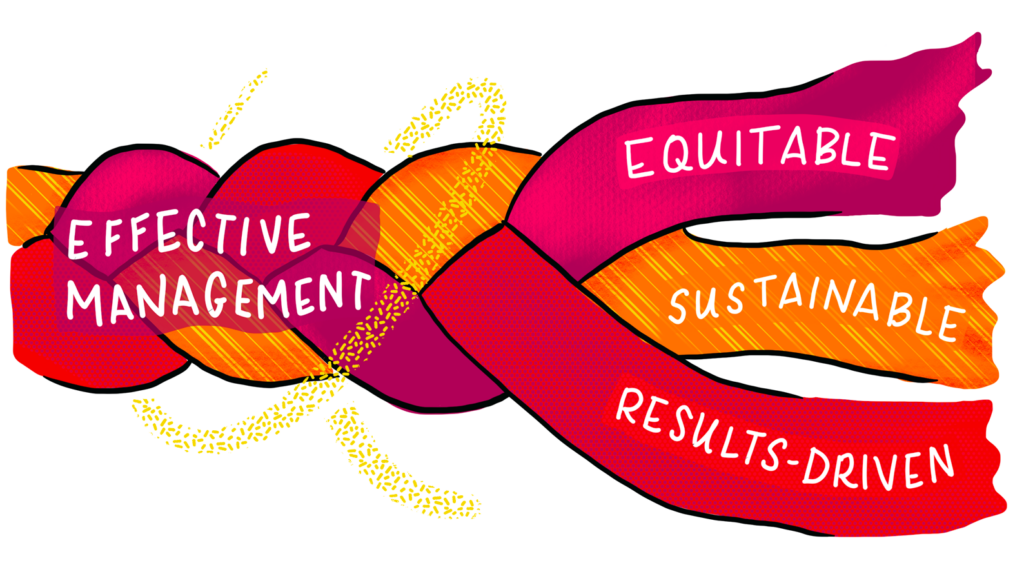
Effective management blends equity, sustainability, and results. Like strands of a braided rope, the individual parts make up the whole, becoming stronger together. Effective managers help people get on the same page for a shared purpose. They balance these three dimensions:
1. Equitable
Effective managers create the conditions for each person to thrive.
If effective management is gardening, the equitable part is recognizing that specific environments favor some plants while creating barriers for others. Armed with that knowledge, managers work to understand the terrain and create an environment where staff (particularly those most negatively impacted by white supremacy and other systems of oppression) experience belonging and can thrive in their work.
2. Sustainable
Managers work with the long view in mind by investing deeply in people, relationships, and systems to produce results, while building a healthy organizational culture that endures over time.
Investing in sustainability is both a strategic and a moral imperative. We call on managers to approach their work the way gardeners tend to soil. This means hiring, retaining, and developing a diverse and talented team and building and refining excellent systems and processes.
3. Results-Driven
Managers make delivering excellent outcomes a guiding priority. By defining clear roles and goals, managers create a culture of shared accountability and commitment to the organization’s mission.
To learn more about each of these dimensions, download our overview.
Get a roadmap to effective management. Check out The Effective Manager’s Compass to identify where you’re thriving/growing and get personalized next steps.
Why Does Effective Management Matter?
Management has a bad rap, and not without reason. Traditional management practices maximize profit or productivity, often at the expense of people. Those environments can be ineffective, bureaucratic, or downright oppressive.
We practice management differently. We know that management can be a force for good when done with the right mix of values, care, and competence. When managers instill shared purpose, build strong relationships, and cultivate belonging, teams work more effectively and strategically to advance their mission.
Where traditional management treats people like machines, we see effective management like tending a garden. We’re not talking about manicured lawns and prize-winning roses; we’re talking about supporting healthy ecosystems that sustain social change movements for generations through stewardship, not control.
Think: conspiring instead of commanding, investing instead of directing, and delegating instead of doing it all yourself. At TMC, we call this the conspire-and-align management approach and we’ve trained thousands of effective managers who:
- See people as humans first
- See management as a relationship, not a production line
- Exercise power with, not power over
- Understand management as a practice, a duty, and a balance
Read more about conspire-and-align management.
Effective Management Toolkit
Using a conspire-and-align approach, these five tools can help you make equitable, sustainable decisions and achieve great results. You will learn to spot implicit bias, communicate more effectively, build stronger relationships, and get better outcomes.
- Sphere of control: Focusing your time and energy only on the things you can control, and letting go of the things you can’t.
- Choice Points: Turning off autopilot and pausing at every “fork in the road” to consider equity implications and alternative options for the decisions you make.
- PTR: Learning to tell the difference between preferences, traditions, and requirements (and focusing on requirements!).
- Make the implicit explicit: Taking the invisible expectations and assumptions you have in your head and articulating them.
- Seek perspective: Getting input from others, especially those most impacted by your decisions.
What Skills Do Managers Need Most?
It’s not easy to balance equity, sustainability, and results when you’re managing people—sometimes lots of people. Developing management skills and consistency in these areas will help you build and sustain a team that’s engaged, focused, and aligned.
1. Relationship-building
Effective managers consistently work to build trust with staff and act with care, competence, and integrity. You follow through on commitments and hold power responsibly.
2. Delegation
Effective managers prepare and delegate assignments clearly, which includes aligning on expectations and seeking perspective from staff (not just barking orders!). You stay engaged throughout the “Delegation Cycle,” holding staff accountable and supporting learning, while adapting as things emerge.
3. SMARTIE goal-setting
Effective managers set strong goals that are Strategic, Measurable, Ambitious, Realistic, Time-bound, and advance Inclusion and Equity. You track progress toward goals and plan status checks for learning, adjusting, and celebrating.
4. Defining clear roles
Effective managers define clear roles and responsibilities for staff. You ensure that people have a sense of ownership and understand what’s expected of them.
5. Hiring, retaining, and developing staff
Effective managers approach hiring and onboarding with clarity, equity, and empathy. You help staff develop skills and mindsets they need to succeed in their roles, and invest in their growth and trajectory.
6. Giving and receiving feedback
Effective managers give regular, quality feedback that is compassionate, direct, timely, and specific. You give both praise and constructive feedback. You also invite feedback from staff (and receive it well).
7. Inclusive decision-making
Effective managers exercise good judgment and regularly ask for input about your decisions, especially from those most impacted. You also communicate your decisions clearly and work to build buy-in.
8. Building healthy team culture
Effective managers work to build a culture that embodies a commitment to excellence, care for people, and shared purpose.
Download the Effective Management Guide
Whether you’re delivering high-quality education for low-income students, advancing progressive policy changes, delivering equitable public services to a city/county, or building grassroots power to protect democracy, you know that effective managers build effective organizations. Changing the world starts here.

Monna is the Chief Content Officer at The Management Center and co-author of “Management in a Changing World: How to Manage for Equity, Sustainability, and Results.” Monna also serves on TMC’s leadership team.