
When you delegate, you give people the opportunity to drive important work, build skills, and contribute to team success. This requires more than handing off a to-do list.
Use the Delegation Worksheet
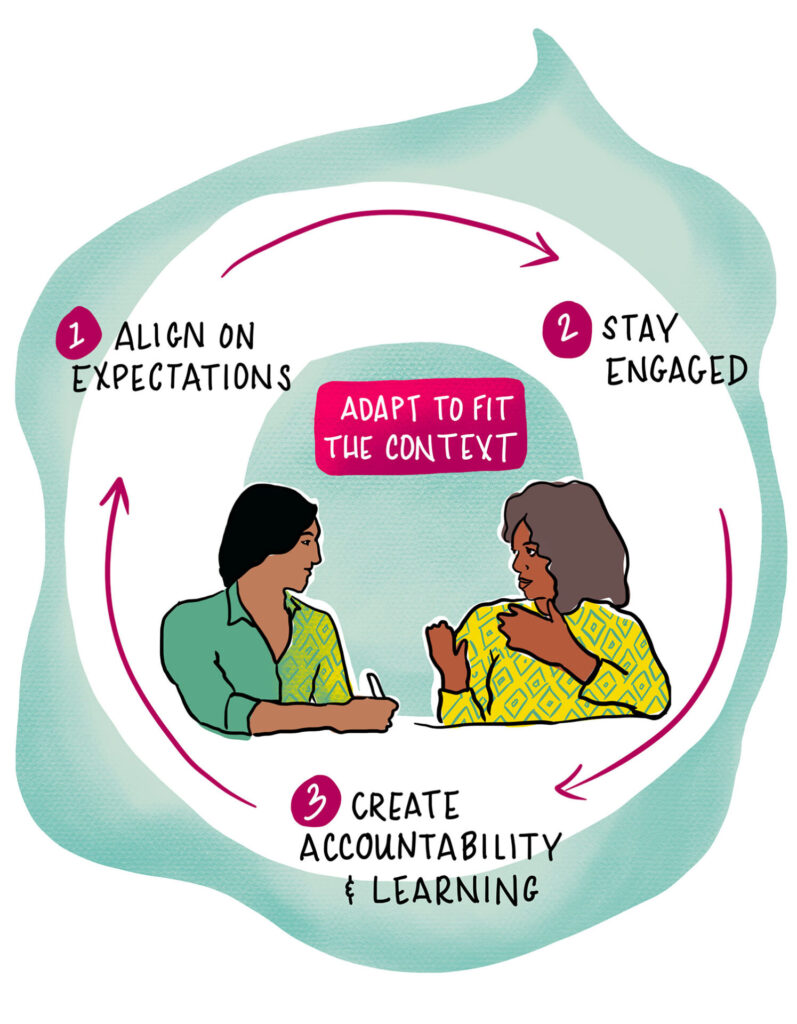
The Management Center’s delegation worksheet can help you prepare for your next delegation conversation with a team member. The worksheet walks you through our three-step process:
- Step 1: Align on expectations. Work through “the 5 Ws” (who, what, when, where, why) and how.
- Step 2: Stay engaged. Decide how you’ll stay engaged to support the work.
- Step 3: Debrief and learning. Plan how you’ll capture lessons, share feedback, and debrief.
Below you’ll find a step-by-step guide to the delegation process and tips for how to delegate tasks effectively.
What is Effective Delegation?
Effective delegation gives people ownership over their work and a chance to grow. It’s a process, not a one-time event.
For managers, effective delegation means investing time, energy, and trust in the people who work with you—trusting them to meet the challenge and giving them the support they need to be successful.
Principles of Effective Delegation
Guide more, do less.
As a manager, your role is like a coach or spotter for a weightlifter. You guide your team members, providing support as they get stronger. When you delegate effectively, you transfer the weight of the work to another team member. This means delegating meaningful areas of work and real authority to drive the work.
Notice choice points.
What you delegate (and who you delegate to) involves several choice points, forks in the road around equity in the work. When you give people your time and attention, along with opportunities to drive important work, they are more likely to advance in their careers. This is a place where your positional power as a manager has an outsized impact on people’s lives. You have a responsibility to pause, spot implicit bias, and course-correct if needed. Delegating equitably builds leadership, strengthens relationships, and ultimately produces better results.
Ask yourself:
- Who do you trust with big projects and high-stakes tasks?
- Who do you tap for exciting opportunities?
- Who might you pass over or even avoid delegating certain tasks to?
Use comparative advantage.
Some delegations are easy to spot (e.g., teachers do the teaching); others require discernment. When you’re not sure what to delegate, comparative advantage can help.
To distinguish comparative advantage, think about everything that’s on your plate (personally or as a team), then consider whether the following criteria apply:
- Impact: Will it have a substantial impact on furthering your organization or team’s mission?
- Role: Does it fit within your role expectations and position in the organization?
- Strengths: Are you excellent—not just good—at the thing? (Alternatively, are you the only one who is excellent or good at it?)
Make the implicit explicit.
This principle is a foundational one. Simply put: don’t expect other people to read your mind. When it comes to delegation, get clear on your expectations and other information your team member needs. Talk through the results you want for the project you’re delegating and get aligned on a shared definition of success. We call this making the implicit explicit.
Ask yourself:
- What’s most important about this piece of work?
- Are there mindsets or approaches that will help to get a great outcome?
- Is there important context I can share that will help them drive the work?
- Do you have an example or picture of what “done” looks like?
As you clarify what’s most important, distinguish your preferences or traditions from requirements. And, if there’s anything you feel unclear about, share it. Invite them to partner with you to get clearer.
Use our delegation worksheet to prepare for delegation conversations, and join our Managing to Change the World training to practice delegating effectively.
The Delegation Process
Whether you’re managing a single team or an entire organization, delegating well requires three things: clearly defining success and expectations, staying engaged along the way, and creating accountability on the back end, all while adapting to fit the context. It’s a cycle with three main steps.
Step 1. Align on Expectations
Get clear about your expectations and get aligned by talking through the 5 Ws (what, when, why, where, and who), and a bit of the how.
The 5 Ws for Effective Project Delegation
- What does success look like?
- When is the project due?
- Why does this work matter? Why are they the right person for the work? Why now?
- Who should be involved?
- Where can the project leader go for resources?
- How should they approach the work?
Start by getting aligned on the “what.” Each person comes to the table with a vantage point shaped by our experience, identities, and role in the workplace. We see things differently and that’s a good thing! Take time to seek perspective from your team members and develop a shared understanding of success.
You might ask:
- When you say Y, I’m picturing ABC. How do you see it?
- What does “finished” look like?
- What will a great event/meeting feel like or include?
- Are there quantitative and qualitative measures that will signal the project is on track or complete?
By the end of your alignment conversation, you should clarify roles using the MOCHA framework and share any resources, deadlines, or constraints they need to know about.
Encourage your staff or team members to use the getting aligned worksheet to surface questions for you about the project.
Step 2. Stay Engaged
Remember: you’re the spotter for the person lifting the weight. Spotters give the right amount of space, encouragement, and notice when it’s time for a step back.
Your role is to structure appropriate supports, ensure accountability, and stay available for problem-solving. The ways you stay engaged will depend on the context and often happen in real-time. Is it a big lift? Brand new skills for them? Brand new for both of you? Find the right balance in conversation with your staff.
These performance management tools are helpful during step two:
- Set up regular check-ins. Use check-ins to ask probing questions so you understand how the work is progressing. You might ask: Can you share your thinking about this? What else did you consider/are you considering? Is there anything you’d like me to do differently to support you?
- Review “slices” of the work in progress. Do you want to see an outline or first draft, guest list, or dry run? As much as you can, build slices into your plan from the beginning, so you can both expect them.
- Find opportunities to observe your team member in action. Seeing how your team members make decisions, handle obstacles, and show their strengths in real-time allows you to give concrete praise you might miss if you relied on a report back. It’s also helpful for gathering more information if you’re worried something is off-track.
Step 3. Debrief and Learn
Create a plan for accountability and learning—yours and theirs. When a project wraps, set aside time to reflect on what you’ve learned together.
To make sure you don’t overlook this step, calendar your debrief at the beginning of the project, even if it’s just fifteen minutes in your regular check-in.
Use our debriefing template to capture lessons and set yourselves up for even better results next time around.
Adapt to Fit the Context
Nothing about management is “one-size-fits-all.” That’s why we consider “adapt to fit the context” an overarching principle of the delegation process. This means taking into account:
- The staff person’s skill, will, and capacity regarding the task at hand. How motivated are they to do it? What’s their capacity in terms of time and energy?
- Your capacity. How much time, energy, and willingness do you have to support them?
- The importance and complexity of the work. How high-stakes is the project or program? How does it stack up against your organizational or departmental priorities? How many stakeholders does it involve? How much of the work is new or unpredictable?
- External circumstances. What else is happening within the organization or in the world that might affect someone’s ability to complete the project successfully? What added support might they need?
Context matters. While your goal is to transfer the weight, coaches help the team adjust the goal post when needed. Effective delegation—like effective management— balances getting results with equitable and sustainable approaches.
Chapter 3 of our book is loaded with more examples of effective delegation. Grab your copy and then practice effective delegation in our Managing to Change the World course!
Download Worksheet

The Management Center is a 501c3 organization that helps leaders working for social change build equitable, sustainable, and results-driven organizations via trainings coaching, and online resources and tools.