
When an employee is no longer a good fit for their role and traditional progressive discipline won’t lead to the improvement you need, “coaching out” can be a kinder and more effective approach.
Consider coaching out when you’ve already tried an informal performance improvement conversation and the employee still isn’t meeting expectations, or when they’re no longer a good fit for the role or organization.
A coaching out conversation should give a staff member real options for the best possible transition out of their role. Learn how to coach someone out of a job below and download our sample script.
Activate your team’s full potential with our Ace Performance Management training package! Gain the confidence and strategies you need to develop staff skills, distinguish growth areas from performance problems, and give better feedback.
What is a Coaching Out Conversation?
A coaching out conversation is an opportunity to discuss performance concerns and next steps with a staff member who you believe is no longer a good fit for their role. You should:
- Share your assessment of their performance.
- Offer possible paths forward (e.g., performance improvement plan, transition out plan, etc.).
- Express your recommendation (e.g., that the staff person leaves).
- Give them space to decide next steps.
When Does Coaching Out Make Sense?
Initiate a coaching out conversation when you believe it’s best for a staff person to leave their role. This might be when:
- You already tried to invest in the staff member through an informal performance improvement process. Even if there is some improvement, they’re still not meeting expectations.
- While the work is generally meeting expectations, the role still isn’t a great fit for their skills or interests.
- The staff person’s capacity or circumstances have changed in a way that could impact their ability to meet expectations.
- The organization is changing, and the staff person is uninterested in adapting to new priorities.
- Even if performance is not meeting expectations, you still think they could thrive in another context.
What Should I Say in a Coaching Out Conversation?
Here are the key components of an effective coaching out conversation:
1. Share Context
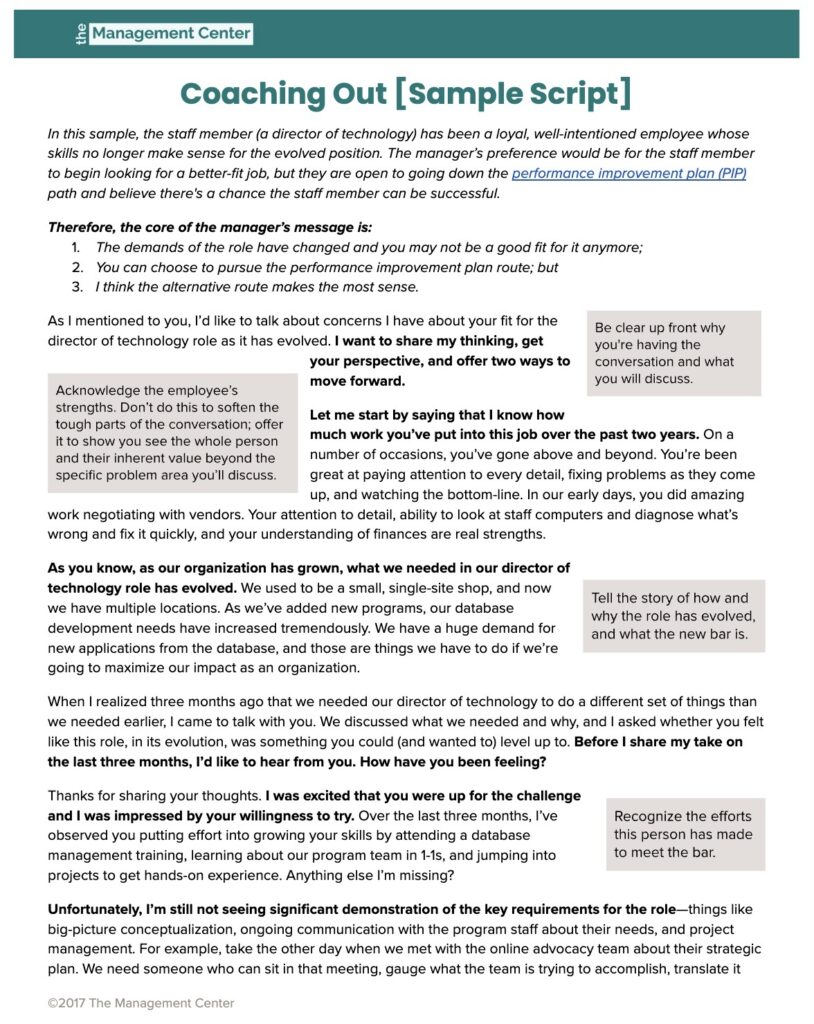
- Be clear up front about why you’re having the conversation and what you will discuss.
- Acknowledge the staff member’s contributions and strengths. Show that you see their inherent value beyond the specific problem area you’ll discuss. If the staff member has tried to improve, recognize the efforts they’ve made to meet expectations (even if they’re still not there yet).
- Focus on the bar for solid performance you need and explain the gap between the staff member’s performance and that bar. Be explicit about areas that need improvement and share examples.
- If the role has changed, tell the story. Share how and why the role evolved. Explain what the new bar is, so the staff member can decide if they are interested in that role.
2. Offer Options
Offer real options so your staff person can exercise agency. When the options aren’t real, coaching out is just “letting go” in disguise. Be honest.
- If you are willing to develop a formal performance improvement plan and really believe it could work, say that. Lay out the next steps and timeline.
- Offer a win-win path. For example, if you mutually agree that the staff member isn’t a good fit for the role, settle on a transition plan that would give them enough time to job search while you hire. Remember to check with your lawyer or HR in advance about what this agreement should look like.
- Be honest about which option you prefer and why, while being clear that the decision is theirs to make.
3. Set a Timeline
Do not force them to make a decision on the spot. Ask if they’d rather discuss now or take some time to reflect. Include a clear deadline for the staff member to decide.
Download the Coaching Out Sample Script
Start drafting a coaching out conversation.

The Management Center is a 501c3 organization that helps leaders working for social change build equitable, sustainable, and results-driven organizations via trainings coaching, and online resources and tools.