
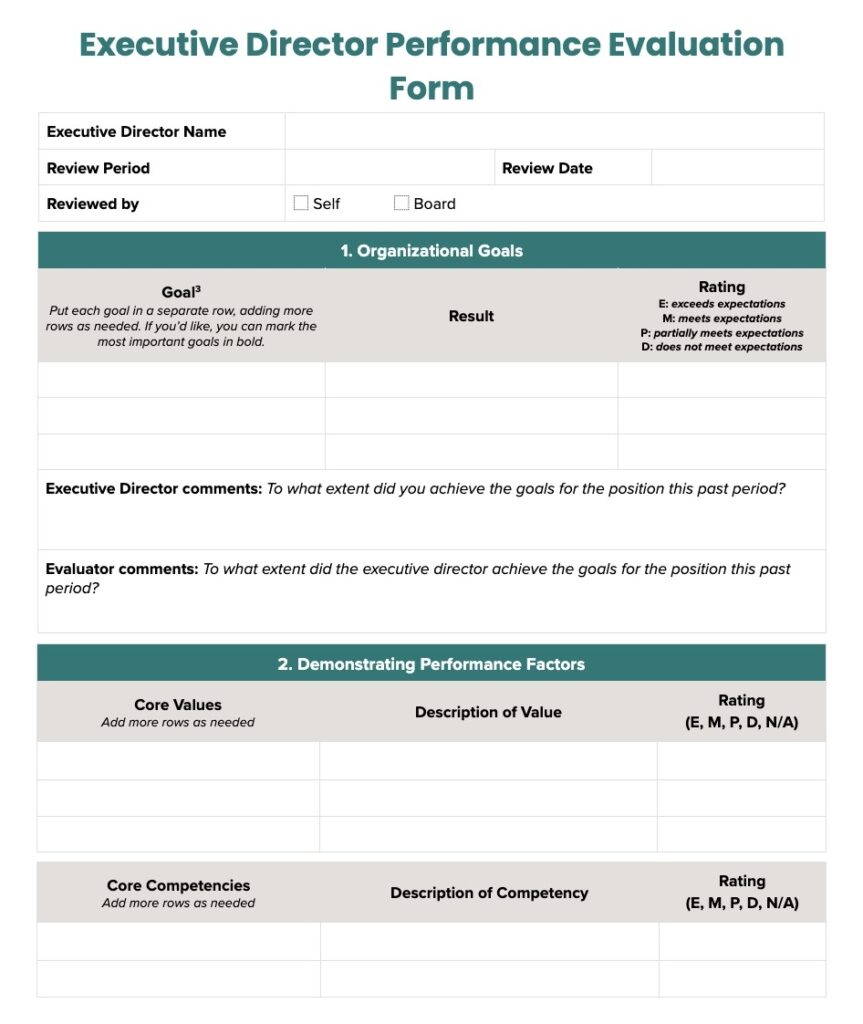
Use our Executive Director Performance Evaluation form to conduct a balanced, rigorous evaluation of your leader’s performance.
Effective leaders create the conditions for getting things done sustainably and equitably. For executive directors, principals, co-directors, and CEOs, this means meeting ambitious and strategic annual goals, laying the groundwork for the future, and leading in a way that’s consistent with organizational values.
As with other staff performance reviews, executive director evaluations should take into account what they have accomplished (results) and how they operate (values and approach). This template can help you assess both.
Unlock your full potential as a leader by enrolling in our Foundations course Managing to Change the World! Gain the confidence, tools, and strategies to delegate effectively, have high-quality check-ins, check your biases, build relationships with your team, and more.
Who Should Conduct the Executive Director’s Performance Evaluation?
For many nonprofits, select members of the board or steering committee (or other volunteer leadership entity) form an evaluation committee to evaluate the executive director’s performance at least annually.
Within school systems, the evaluation committee may include members of district leadership, school boards, or other bodies that oversee state education standards.
What Best Practices Should I Keep in Mind?
- Lay the groundwork.
The board and executive director should align at the start of the year on the most important strategic goals for the organization. The evaluation should reflect and build on progress reports and discussions throughout the year. - Broaden your perspective.
Seeking input can bring rigor, help offset individual bias, and help boards identify patterns or inconsistencies, especially across lines of difference or power. Ask staff, partners, and key stakeholders for input on the executive director’s performance. Solicit feedback via survey, confidential conversations, etc. - Prepare for the conversation.
Both the executive director and the evaluation committee should fill out the form. The director will complete the form as a self-assessment; the committee will use the form to evaluate the director’s performance. Take into account the executive director’s work products, role expectations, data on the organization’s progress toward goals, and feedback from key stakeholders.
What Should an ED or CEO Performance Review Include?
TMC’s performance evaluation form for executive directors and CEOs consists of four parts:
- What was achieved?
The first section focuses on the extent to which the executive director is leading the organization to accomplish its goals. (In cases where unforeseen opportunities or challenges arose during the year, they should be added here.) - How was it achieved?
This section focuses on values that all employees are expected to demonstrate (which the ED should model), as well as competencies and behaviors that are specific to the ED position. - Summary assessment and next steps.
This section captures overall performance for the year and identifies strengths, areas for improvement, and next steps. - Feedback for board and board self-reflection.
This section gives both the board and the director space to reflect on what’s working and what support is needed moving forward.
For the first two sections, we recommend using the following rating scale:
- Exceeds expectations: Consistently delivers exceptional results; is a model for others to follow.
- Meets expectations: Consistently meets expectations in all areas.
- Partially meets expectations: Meets expectations in some areas and needs improvement in others.
- Does not meet expectations: Needs significant improvement quickly.
Key Steps for Executive Director Performance Evaluations
- Executive director completes self-evaluation form and sends to evaluation committee.
- Evaluation committee gathers input from stakeholders.
- After reviewing the executive director’s self-evaluation, input from stakeholders, and results achieved, the evaluation committee drafts evaluation and sends to executive director.
- Executive director and evaluation committee meet to discuss and align.
- Evaluation committee makes changes (if needed) and submits finalized evaluation to full board.
- Board discusses conclusions, votes to approve (or, in rare cases, modify), and confirms next steps.
How Do Executive Director Evaluations Differ from Staff Evaluations?
There are two key differences that distinguish executive director evaluations from standard staff evaluations:
- Executive director evaluations take into account overall organizational accomplishments, including progress toward long-term goals (mission).
- The evaluation is typically discussed by the entire board without any staff present (though only one or two committee members may share the board’s assessment and feedback with the executive director).
How Should I Use This Template?
Members of the evaluation committee can use this template to assess the executive director’s performance. The executive director can use this form to self-evaluate and share feedback with the board.
To make the most of this template, customize it. Insert the goals, organizational values, and core competencies that you expect from the executive director. Outline the key deadlines for your evaluation process. Add or remove sections as needed.
Download the Template
Get your editable version to start the executive director evaluation process.

The Management Center is a 501c3 organization that helps leaders working for social change build equitable, sustainable, and results-driven organizations via trainings coaching, and online resources and tools.