
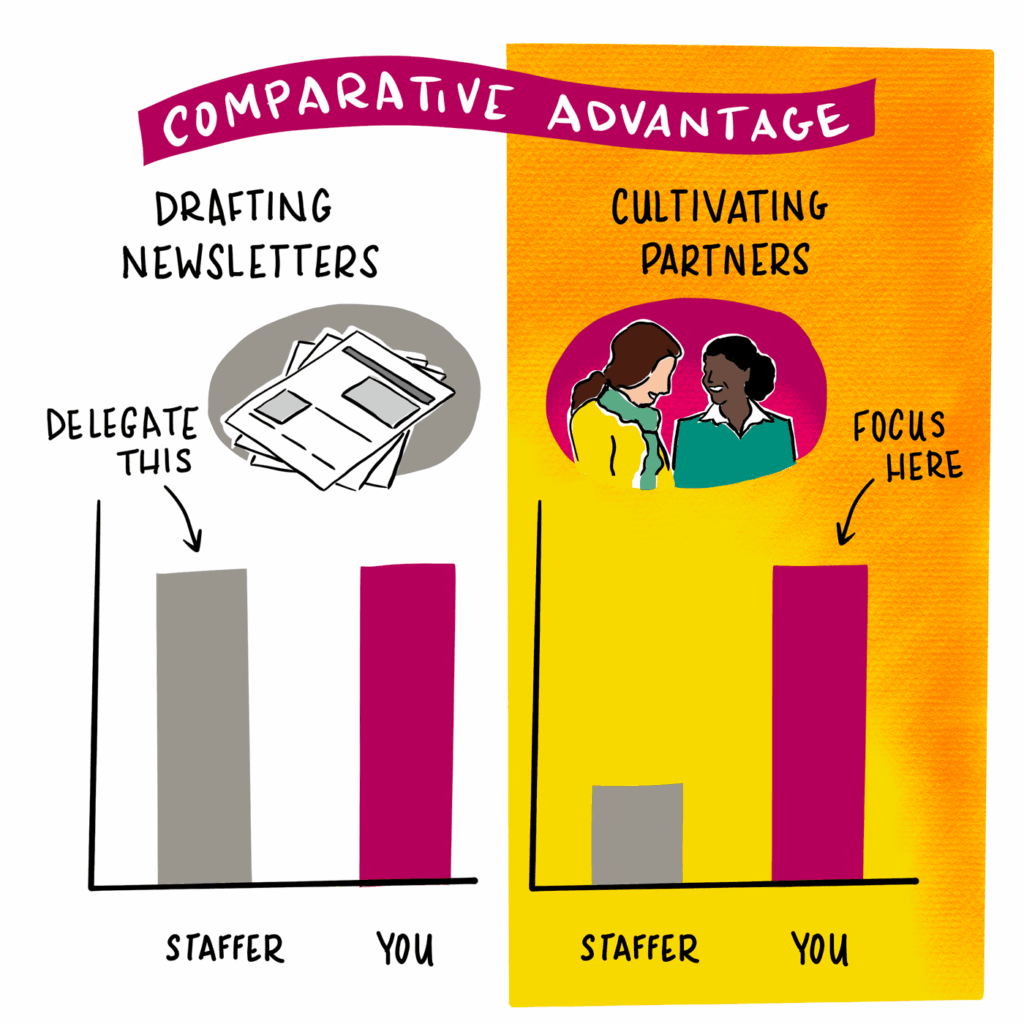
Comparative advantage helps you decide what work you should own and what to delegate to others.
When you delegate effectively, you spend your team’s resources where they’ll make the greatest impact. That means not keeping all the work on your (already crowded) plate, even if you have the ability to do it yourself.
Get clear on each staff member’s strengths within their role (including your own). Evaluate the impact each piece of work will have. Delegation 101 cheat sheet:
- If the task or project will make a big impact, fits squarely within your role, and aligns with your strengths, you should keep it on your plate.
- If not, delegate or deprioritize that piece of work (even if you’d be good at it or enjoy doing it).
For managers, understanding comparative advantages can help you craft role expectations, design MOCHAs, figure out the division of labor on your team, and reprioritize.
Unlock your full potential as a manager by enrolling in our Foundations course Managing to Change the World! Gain the confidence, tools, and strategies to delegate effectively, have high-quality check-ins, check your biases, build relationships with your team, and more.
How Do I Know When to Delegate?
Identify comparative advantages for each person on your team. Think about everything that’s on your plate and consider the following criteria for each item:
- Impact: Will it have a substantial impact on furthering your organization or team’s mission?
- Role: Does it fit within your role expectations and position in the organization?
- Strengths: Are you excellent (not just good) at the thing? (Alternatively, are you the only one who is excellent or good at it?)
If you can answer yes to all three questions for an area of work, then it should stay on your plate.
If there’s anything on your list that doesn’t hit at least two of the criteria, move it off (by delegating or deprioritizing altogether).
For items that only hit two of the three criteria, consider whether you should:
- Delegate: if it doesn’t make sense to do as part of your role or if it’s not a strength
- Develop your skills: if it’s not currently a strength but is a must-have for your role
- Reconsider entirely: if it’s not high-impact
Comparative Advantage Examples
Consider which areas of work allow you to make the greatest impact and leverage your strengths. Move the rest off your plate.
Here are a couple of examples:
Communications Director
You are a new Communications Director and your team needs to execute a full website redesign this year.
Impact and role: A project of this scale and impact fits within your role.
Strengths: However, your strengths are in public relations, messaging, and earned media work, and you have a staff member who has managed web redesigns before. If you had skills in web design and management, this would likely fall within your comparative advantage.
Delegate or not? Using the principle of comparative advantage, you decide to delegate ownership of the project. Your next step is to think through the 5 W’s, develop clear guidelines on the decisions that need your input and approval, and set up a delegation conversation with your staff member to get aligned on expectations and the MOCHA.
Chief Development Officer
You are the head of development at your organization. Your team needs to draft several grant proposals this year.
Impact and role: As the leader of your team and the person with the most long-standing relationships in your community, cultivating major donor relationships is a more strategic use of your time and skills (even if you might enjoy writing proposals or be really good at it). You already have members of your team who were hired to write grants.
Strengths: You have a lot of experience with grant proposals—perhaps more than anyone else on your team. At the same time, some of your staff members’ specialty is writing grant proposals.
Delegate or not? Your time is better spent managing staff who will draft grant proposals. As their manager, you can develop their skills around donor cultivation in order to support the sustainability of your work.
For more support on identifying your comparative advantage, check out our Comparative Advantage Worksheet.
Tips For Delegating Effectively with Comparative Advantage
To delegate effectively with comparative advantage, we recommend the following:
Only do what only you can do.
Consider this a rule of thumb for identifying your comparative advantage—what are the things that only you should do, by nature of your role, position, or your competencies? This tip is especially important if you’re managing someone whose job you used to have. It’s common and tempting to hold on to the work that is familiar and that you’re good at. But their job isn’t your job anymore—your job is to manage.
Be mindful about what you pass off (and to whom).
It’s tempting to use comparative advantage to pass off work that you don’t enjoy or aren’t good at. Sometimes, this is the right call, especially if the tasks are time-consuming and your energy would make greater impact elsewhere. However, make sure that you’re delegating intentionally and equitably. Women, and particularly women of color, often get burdened with the (often invisible) logistical and emotional work that make an organization run (consider who was assigned to be a notetaker at your last meeting). If you frequently find yourself delegating ongoing tasks (like fielding inquiries, scheduling, etc.) that become extra work for others, make it an explicit part of someone’s role.
You might not be good at everything (and that’s okay).
There may be things on your plate that only meet the “impact” and “role” parts of the comparative advantage criteria. They make sense for you to do given your role and they are mission-critical, but you’re not great at them and they can’t be delegated. In those cases, focus on developing your competencies (which may involve delegating more to free up time and energy for learning!).
Now, get started with our Comparative Advantage Worksheet!

The Management Center is a 501c3 organization that helps leaders working for social change build equitable, sustainable, and results-driven organizations via trainings coaching, and online resources and tools.