
Role expectations set staff up to succeed and bring consistency to performance management. Effective role expectations clarify:
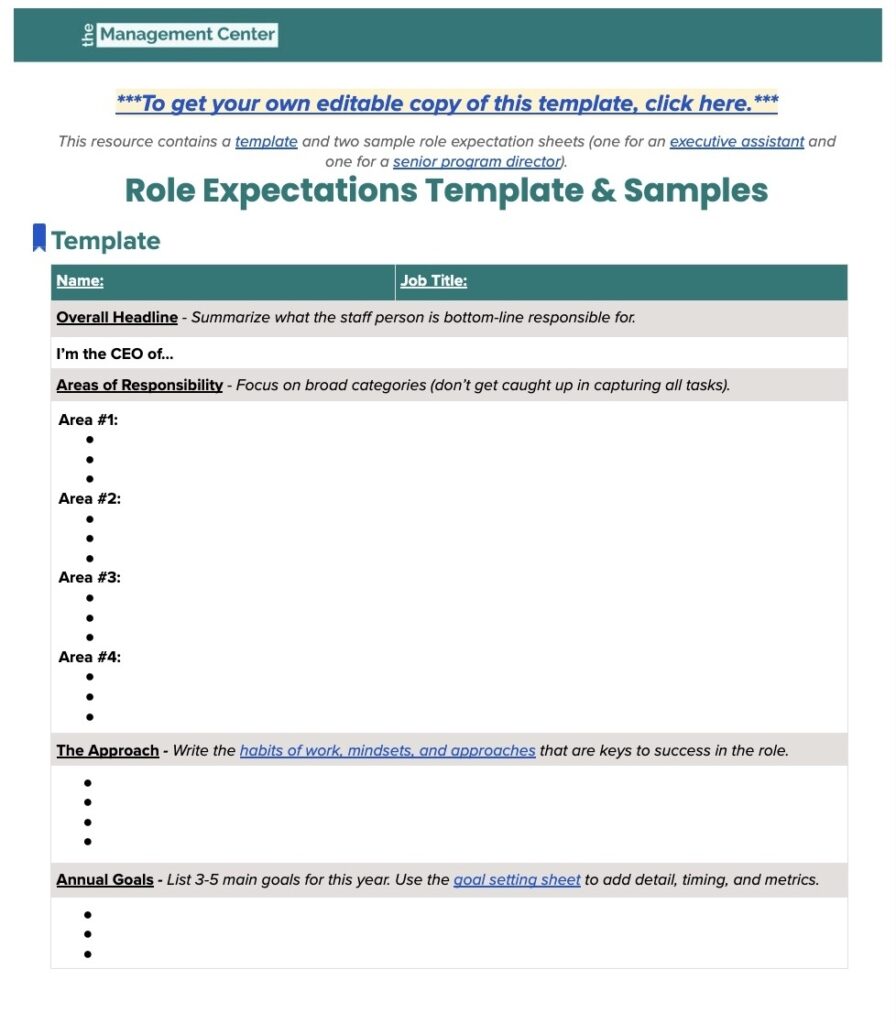
- Purpose: their unique contribution or “I’m the CEO of…” statement
- Scope: “what” they’re responsible for; where they drive results
- Approach: “how” you expect them to apply organizational values, problem solve, etc.
Use this employee expectations template to define what your staff is responsible for and how they should approach their work.
Use it when you need to turn a job announcement into job expectations for your new hire, establish a new role, or re-clarify job roles during periods of organizational change. The template includes two examples (one for an executive assistant and one for a senior program director).
Unlock your ability to lead an all-star team by enrolling in our Build an Empowered Team training package! Gain the confidence, strategies, and hands-on experience you need to hire great people, define clear roles and goals, and give quality feedback.
How Should I Set Role Expectations?
For each member of your team, develop a one-page description of the role. We recommend breaking role expectations down into three parts.
Purpose: Craft a “CEO statement”
A “CEO statement” is a high-level, one sentence summary of a role’s overall purpose. A clear statement can help staff better understand what they’re responsible for and where they have agency to make decisions. It can also support staff to feel more invested in their work.
Use this sentence structure: “As the [role], I am the CEO of ____________.” Encourage your events coordinator to think of themself as the “CEO of events logistics” or your communications director to be the “CEO of media relations.”
You can also invite your staff member to craft a CEO statement in their own words so it’s more memorable and meaningful to them.
Scope: Define the “What”
Identify 3-5 core areas of responsibility where this person drives results. They should be clear enough to define success, but broad enough to give the staff member space to innovate and propose new ways to achieve outcomes.
Example for a senior manager: Build, manage, develop, and retain a strong staff team.
- Ensure all staff have clear role expectations and individual goals.
- Reinforce goals by regularly communicating priorities and ensuring staff meeting time is used effectively.
- Hold staff accountable for results through regular feedback and performance management.
- Proactively retain high-performing staff.
- Lead (or manage others who lead) hiring as needed, ensuring a strong, diverse candidate pool, equitable hiring process, and successful onboarding.
You don’t need to capture every task. Define “buckets of work” that match your performance expectations, and resist the urge to list every process or step. When managers only specify activities or tactics, it limits the role to the approaches that the manager prefers, which can lead to inequities when managing across lines of difference and power.
Approach: Communicate the “How”
Identify what it takes to be effective in the role to set expectations for how staff approach their work, including mindset, behaviors, and organizational values.
Consider the following questions:
- What mindsets will most help the staff member succeed in the role, the team, and the organization?
- What values or behaviors will be a core part of performance evaluations?
- What approaches are necessary to advance your organizational commitment to equity? How should this person put these values into practice in their role?
Competencies you tested for when hiring should show up here (e.g., takes initiative, innovates, learns from mistakes, consistent attention to detail, solution-oriented).
Keep in mind: your expectations may come from your personal preferences and org culture. Get clear on what’s really required to succeed in the role, using our PTR framework. Ensure you hold all your staff members to similar standards.
Employee Expectations Template Example
Below are sample role expectations for an executive assistant role.
Purpose: “I’m the CEO of…”
I’m the CEO of making sure the executive office runs smoothly.
Scope: the “What”
- Administration/Operations: Office space is functional and everyone has what they need to do their jobs well.
- Calendar and internal meetings: Manage calendars and implement internal meeting structure.
- Tech and systems: Technology is appropriate to meet the needs of a growing team and we have the systems in place and working to gather, share, track, and secure information.
- Events and special projects: Own and help on other events and projects as needed.
Approach: the “How”
- Manages a high volume of work with efficiency: Able to juggle competing demands and prioritize without sacrificing quality.
- Entrepreneurial and resourceful: Consistently overcomes challenges and leverages resources to creatively solve problems.
- Attention to detail: Notices and fixes errors that others might overlook.
- Strong sense of ownership and resilience: Plans ahead and finds alternative paths, when needed, to get to the finish line.
- Trustworthiness and realness: Builds authentic relationships and follows through on commitments.
Best Practices for Developing Role Expectations
Clear employee expectations support staff to take greater ownership over their work. As you develop job expectations for each staff member, we recommend:
Lean on their expertise and skills.
When crafting a role description, take into account your staff member’s comparative advantage. Delegate work that leverages their talents and share why they are the right person to drive this stream of work forward.
Be explicit about decision-making power.
Specify where they have full decision-making authority. Name where they need to consult you, get approval from you, or get approval from others.
Zoom out.
Use role expectations to connect their work to your overall team goals and organizational mission. Link to team or organizational competencies based on job title. Connect approach to organization values. Clarify division of labor across the team, so everyone knows each other’s CEO statement and core responsibilities.
Avoid micromanaging.
After setting role expectations, let your staff take the wheel. Grant them the space and autonomy to drive work forward, so you can focus on guiding and coaching.
Download: Role Expectations Template and Examples
Get an editable template to define clear role expectations for each member of your team.

The Management Center is a 501c3 organization that helps leaders working for social change build equitable, sustainable, and results-driven organizations via trainings coaching, and online resources and tools.