
As a leader in social change, education, or governance, you need strong prioritization skills to identify what truly deserves your “yes.” In other words: you need to know how to prioritize work. Prioritization helps you… and it requires discernment, confidence, and input.
This guide includes practical steps to help you identify priorities, assess their importance, and create a to-do list you feel confident about. With your priorities at the center, and your goals in mind, you/your team can work more effectively and sustainably.
Learn more about managing work effectively by signing up for our Manage Successful Projects training package for managers or staff! Gain the confidence, strategies, and hands-on experience you need to deliver results and lead projects with impact.
Step 1: Define a North Star
Grounding in your purpose will help you get clear on top priorities. A clear purpose—whether that’s your mission or this year’s goals—illuminates your highest impact work, especially when things don’t go according to plan.
Before getting into specific tasks, think about your broader purpose, your North Star. Ask yourself:
- What am I running toward?
- What would I feel proud to achieve in this role?
- Why am I doing this work?
Step 2: Identify Big Rocks
What are big rocks?
Big rocks are the most important things you need to do, the tasks or projects with the greatest impact. They are strategic priorities that represent real progress, and determine whether your day, month, or year is successful. When you accomplish them, they drive the work forward (or call for a celebration).
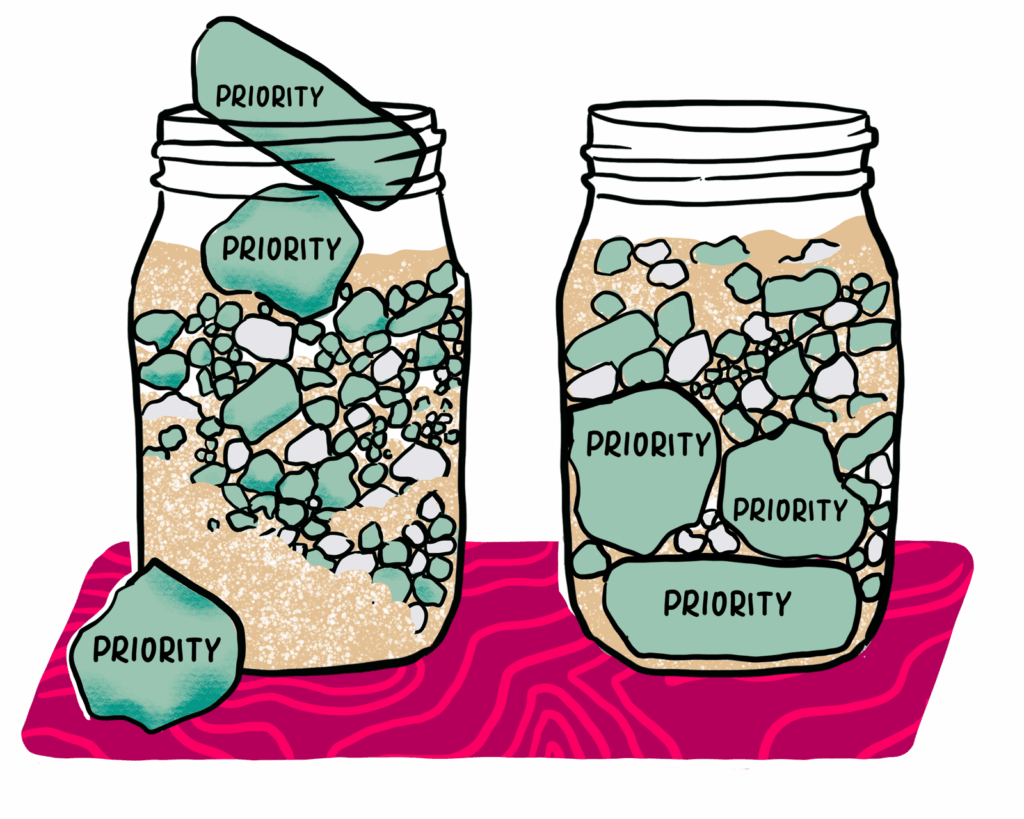
Imagine you have a jar, a few large rocks, and a bunch of small pebbles. If you start filling the jar with pebbles, by the time you get to the larger rocks, they’re either precariously balanced near the top… or they just don’t fit.
But, if you put the largest rocks in the jar first, not only do they all fit, there’s still space for the small pebbles to fill in the cracks.
This jar represents your valuable, limited time and energy. The rocks and pebbles are the projects and tasks on your plate. The big rocks represent your highest impact priorities, while everything else is proportionally less important or urgent.
It can be tempting to do small, easy-to-tackle tasks first, because they’re easier to start and it feels good to check stuff off a list. But, have you ever reached the end of the day and realized that you (yet again) haven’t made progress on that important, looming project? When that happens, you’re putting pebbles in the jar first. Choose your big rocks first to make headway. Most of the time, the pebbles still fit. (See Step 3 if they don’t.)
Credit to Stephen Covey for popularizing the “big rocks” prioritization framework.
How to identify big rocks for your to-do list
Your big rocks should complete this statement: “Even if I do nothing else [in X time period], I will be successful if I ______.”
The scale of your big rocks will depend on the timeframe. For example, your yearly big rock could be an annual goal, while your quarterly big rock is a specific campaign or step that meets that annual goal, and your daily/weekly big rocks are individual tasks associated with the campaign/project.
You should identify and prioritize big rocks at every level of your work—like a Russian nesting doll of priorities! For your daily or weekly to-do list, your big rocks will likely fall into these categories:
- Tasks associated with major projects. These are the projects that, once completed, represent your biggest accomplishments. They’re usually connected to your goals or listed as key responsibilities in your role description. These projects typically involve lots of tasks spread out across days, weeks, or months.
- Building or refining systems. These are tasks that build or maintain the processes that are critical for supporting or streamlining the rest of your work (e.g., learning a new software, troubleshooting website issues, automating data collection, etc.).
- For managers: tasks associated with management, goal-setting, and planning. Examples include: preparing for evaluations, setting annual goals, giving feedback, or budgeting.
Once you identify your big rocks, boost them to the top of your to-do list and place other tasks in a separate section below. If other important to-dos have an urgent deadline attached, they may rise to the level of a big rock just for the day.
If it feels difficult to start a big rock, try breaking it down into smaller, more doable steps in your to-do list. Smaller tasks, like scheduling a workblock or starting a document, can build the momentum you need to keep going. Use our Daily List Template to get started.
Want to learn best practices for prioritizing your big rocks? Enroll in our Foundations training for staff, Working for Change! Gain the confidence, strategies, and hands-on experience you need.
What about other important tasks?
Big rocks are not your only priorities. There are other important tasks, such as:
- Miscellaneous (including stuff you owe other people!). Whether it’s filling out timesheets, reviewing someone’s draft proposal, or preparing for a performance evaluation, these tasks may not be directly mission-critical, but they need to get done.
- Personal care and sustainability. You might have non-work related big rocks, because—let’s face it—important personal to-dos (like finding a mental health provider or booking a trip to visit family) can affect every part of your life. Even the ones that seem small in the moment, like scheduling a lunch break every day, can have a big impact on your personal sustainability.
Step 3: Assess Urgency and Importance
Struggling with priority overload? If everything feels like a big rock, use the Eisenhower Matrix to identify your most important to-dos.
Using the Eisenhower Matrix with your team
The Eisenhower Matrix divides tasks into four quadrants, based on their urgency and importance.
- Take inventory of your current tasks, projects, and commitments.
- Reflect on whether a task is urgent:
- Does it require your immediate attention?
- Will there be a clear, time-sensitive consequence if you don’t prioritize it now?
- If you avoid it, will it snowball and create more stress later?
- Reflect on whether a task is important:
- Is it one of the big rocks you identified in Step 2?
- Will doing it help you advance your most important work?
- Is it squarely within your goals?
- Populate the quadrants to determine what to do, schedule, delegate, do in “good enough” mode, or drop.
Looking for help with reprioritizing when your capacity or circumstances change? How to Reprioritize Work complements this article.
The Eisenhower Matrix
| Urgent | Not Urgent | |
|---|---|---|
| Important | Urgent & Important Do these first. Put them on your to-do list as big rocks. | Important & Not Urgent Schedule time to work on these and set clear deadlines. Priorities like creating a building evacuation plan, implementing sustainability practices, or cultivating community relationships need attention before they become urgent—or even too late. |
| Not Important | Urgent & Not Important Delegate or do in “good enough” mode. These are tasks that are time-sensitive, but may not contribute directly to your goals, fall within your core responsibilities, or make the highest impact. | Not Urgent & Not Important Drop it to the bottom of your to-do list, or take it off completely. |
Managers: You have more line of sight into your team’s goals, capacity, and priorities than the people you manage. You also have more power to lighten the load so your staff can stay focused on their highest impact work.
When you’re the one delegating your “Urgent, Not Important” work to staff, be mindful of what’s already on their list, ask about their current capacity, and communicate how the new task should fit into existing priorities. Use check-ins to review what’s on their plate and suggest items they can delegate, do in “good enough” mode, or drop. And, do a bias check to make sure you’re offering support equitably across the team.
Staff members: If there’s not enough space in your jar, consult your manager. During check-ins, ask them to help you think through what you can delegate or drop. Lean into your sphere of control and make proposals for how to complete a task in “good enough” mode, negotiate timelines, or get support from other team members.
Step 4: Plan for the Unexpected
Prioritization is a dynamic process. As your context changes, your priorities may need to shift. Stay resilient and adaptable by building buffers:
- Build open space into your project plans for unexpected shifts. Use that time to reprioritize and communicate changes to your manager or team.
- Keep a “backburner” list, tasks that aren’t urgent now but might become big rocks later.
- Regularly reassess. Use the start of a new quarter or organizational planning cycle to review priorities. Regularly align on big rocks during check-ins or goal stepbacks.
Prioritization is a Practice, Not a One-time Fix
Prioritization should be an ongoing practice where you assess, adjust, and align with your most important goals. By evaluating your workload, you can ensure you spend your limited time and energy on what drives impact, not only on what feels urgent. Frameworks like big rocks and the Eisenhower Matrix can help you focus.
Most importantly, let go of perfectionism and remember that success isn’t about doing everything at once; it’s about doing the right things well.
To keep your priorities on track:
- Ground in purpose so that you know what will make the highest impact.
- Focus on your big rocks, instead of trying to do it all.
- Assess urgency and importance to adjust your workload.
- Make prioritization a habit—not just a reaction to feeling overwhelmed.
Need help prioritizing in the face of change or uncertainty? Check out tips for reprioritizing.

The Management Center is a 501c3 organization that helps leaders working for social change build equitable, sustainable, and results-driven organizations via trainings coaching, and online resources and tools.