We coach clients through decisions about internal promotions, staff retention, and hiring every day. We often hear questions like these:
- “I need to do external recruitment because I’m not confident we’d have a strong internal pool. How do I explain that without killing morale?”
- “I have a staff member I would like to promote. But she doesn’t want to manage people, and that’s part of the promotion. What should I do?”
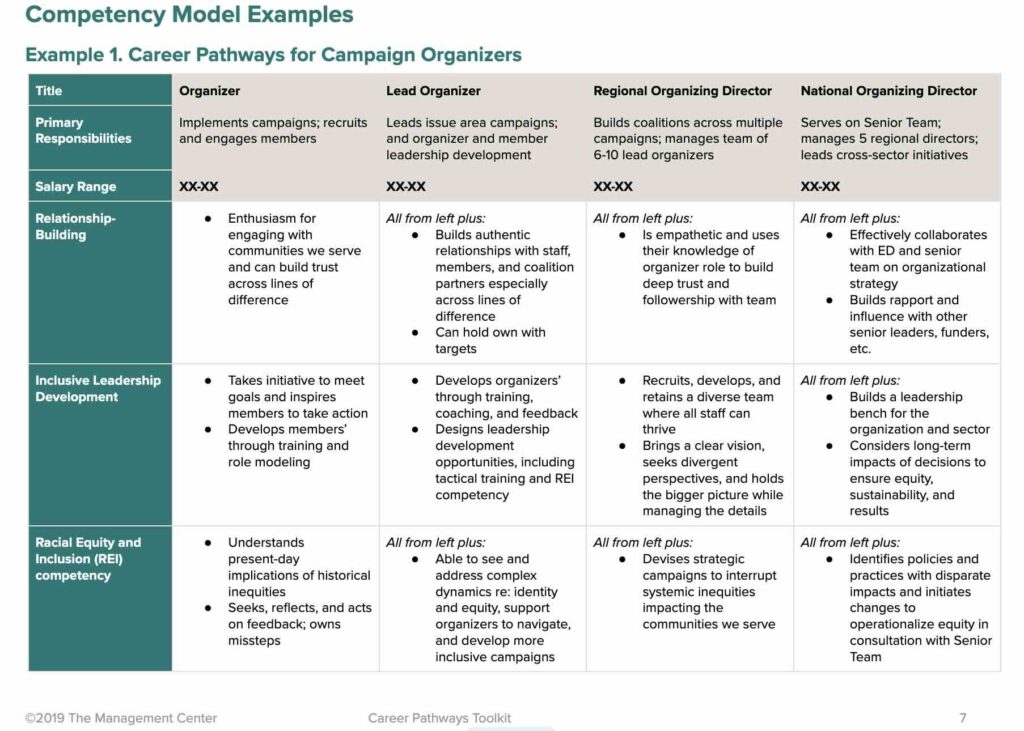
A competency model (or career path framework) can help you:
- Take the guesswork out of advancement for staff
- Bring consistency to hiring and performance management decisions
- Develop your leadership pipeline at all levels
This step-by-step guide helps you develop a competency model for your team or organization. It provides key definitions, free templates, and real-world examples.
What is a Competency Model?
A competency model defines the knowledge, skills, and approaches for each position (job class) in an organization or team. Sometimes called a career path model for HR, each role/position has distinct must-have* responsibilities, often with progressively greater responsibility. Pathways may distinguish:
- Scope of responsibilities
- Complexity of activities, partnerships, or campaigns
- Volume of work or level of efficiency needed
- Ability to drive the work in an area or for the organization
- Positional power and influence inside/outside the organization
Suppose you’re articulating the career path for your Operations and Finance teams: you’ll start by defining the competencies needed for each job, and then define how those competencies evolve at increasing levels of responsibility (from Assistant to Associate to Director).
With this framework, you can articulate what someone needs to do to be successful in a job and progress in the organization, as well as their career goals.
*Not sure about the must-have competencies? Use our Figuring Out the Role Worksheet.
Key Definitions
Must-Haves: The required skills, knowledge, and mindsets to succeed in the particular role.
Competency model: The must-haves that distinguish each position across a range of job roles in a team, organization, or profession. Sometimes called a career pathway framework or career path model.
Benefits of a Competency Model
A thoughtfully designed career path framework can operationalize your commitment to equity and inclusion.
For Managers
A competency model brings consistency to the rubrics managers use to eliminate bias in hiring and performance management, while guiding managers to think through opportunities or training that helps staff achieve their career goals. It guides staff development and retention conversations, informs promotion and hiring decisions, and anchors performance evaluations.
For Staff
A competency model takes the guesswork out of advancement. It helps staff understand how to get from point A to B (or C), which onramps are available, and what bridges they need to build. It empowers staff to take charge of their growth and think ahead about their trajectory in the following ways:
- Short-term: What do I need to be successful in my current job?
- Medium-term: What do I need to do to get to the next level?
- Long-term: What options might I have to shape my career in line with the organization’s plans and strategy?
It can also reveal avenues for “zigzag career paths” instead of assuming “straight-up the ladder” is their only option to grow, and it can give staff insight on the skills and qualities managers look for when it comes to promotions and performance evaluations—where we always recommend “no surprises.”
For the Organization
Developing written career pathways can help the organization spot roadblocks in its leadership pipeline.
Each pathway you identify should strengthen the leadership bench and reflect equitable opportunities for staff at all levels. This means each decision you make in developing your competency model is a critical choice point where you can pause, spot, and address inequities in particular job roles.
For example, you might acknowledge that your operations team includes the most new staff members, many of whom are BIPOC and work part-time roles. In putting together your career pathways, you would gather input from staff and deliberately build in opportunities or new levels that could enable a part-time associate to eventually advance to coordinator, then manager, etc.
6 Steps to Establish a Competency Model
Your goal is to develop a tool that is broadly understood, trusted, and actively used to inform decisions. Consider the most prevalent roles in your organization. Download the toolkit for a deeper dive on each step.
Step 1. Create a project plan and MOCHA
Ensure the project “owner” (in MOCHA terms) is a senior leader with a track record of managing and developing people. The project owner also needs demonstrated racial equity and inclusion competency (spots disparities or opportunity gaps) and relationship-building skills (proactively engages staff members and managers for input).
Note: if you don’t have the authority to initiate a career pathways project at the organizational level, you can always start by defining competencies for your team or department.
Step 2. Select roles with pathway potential
As you think through each pathway or competency level, seek input. This is a crucial choice point. So pause, reflect, and mitigate bias in each decision you make as you develop your pathways.
Step 3. Define competencies
List the competencies and define them. Focus on the qualities, approaches, and demonstrated skills that amount to solid performance in each role. See toolkit for examples.
Step 4. Delineate what changes level by level
Look at the different job titles people carry, especially where responsibility increases or something else differs. Consider what changes from level to level, then pause.. This is another choice point for your organization. Research shows that implicit bias shapes who gets seen as a leader. Ask yourself:
- Who could be held back or excluded—and who could benefit—from the way we define this level?
- What input should I gather to check my assumptions—and from who?
- How will the pathway we create explicitly interrupt racial bias and other workplace inequities?
The Career Pathways Toolkit includes a chart that illustrates how you can differentiate levels with these questions in mind.
Step 5. Look for roadblocks and build intersections
Developing a competency model can help you spot gaps in your leadership pipeline. Get input: When a staff member reads the competency model for their role, can they:
- Articulate why they’re at their current level?
- Identify 2-3 competencies they need to get to the next level?
- Do they know where to get support to develop those competencies?
Create learning and development opportunities where you spot gaps in staff advancement.
A note on equitable compensation: We also recommend youdefine salary ranges or compensation bands for each level with some overlap.
Step 6. Put your career pathways tool to work
Start using your competency model as a reference point for hiring, promotions, and performance evaluations. Here are a few ways you can put the pathways tool to work:
- Check-ins and stepbacks. Discuss the tool with the people you manage: “When you think about your trajectory here, where do you see yourself? What can I do to support your next step?
- Hiring and promotions. Discuss it with the managers you manage: “How did the staff member/candidate do against the competencies we’ve articulated for this role?”
- Performance evaluations. Reference it when you summarize strengths and areas for improvement: “When it comes to Problem Solving, you did great on project X and stumbled a bit on project Y. This is a competency needed to level-up to a Senior Manager (“tackle the most complex topics and develop breakthrough solutions”), and it’s a role I think you could stretch toward.”
Use our sample check-in agenda, performance evaluation form template and hiring rubric starter kit.
Best Practices for Nonprofit Competency Models
- Prevent inequitable outcomes in hiring and promotion decisions. Bring transparency to the process by setting guardrails managers can use to inform hiring and evaluation rubrics and mitigate bias.
- Ensure career progression doesn’t always look like a ladder. Define “lateral” paths for building experience. Give equal value to “destination” roles and “stepping stone” roles, and offer “next level” opportunities based on deepening expertise or scope, not only becoming a manager of people.
- Help staff reach their career goals. Support staff to develop leadership and explore opportunities inside as well as outside the organization. Talk to staff about personal goals during check-ins, stay conversations, and evaluations.
Who Should Use TMC’s Career Pathways Toolkit?
Executive leaders and HR professionals can use the toolkit to define organization-wide job classifications with core competencies, and managers (at any level) can use it to define positions within a team or department.
Download the Career Pathways Toolkit

The Management Center is a 501c3 organization that helps leaders working for social change build equitable, sustainable, and results-driven organizations via trainings coaching, and online resources and tools.